Monday, February 18, 2008

Hard Day's Night, Part Two: Night


(...we join our heroes, back home in Strasbourg after a long Sunday of cycling through rural Germany).

After a not-nearly-restful-enough two hour nap, we were roused just before midnight by the electronic yelping of our alarm clock.

“Do we have to go?” asked Amynah, drowsily.

“Well, we should,” I replied, unenthusiastically.

“We could just call and cancel,” she suggested.

“Maybe we could have a bite to eat, then see how we feel,” I replied.

Tearing ourselves from the soft, warm embrace of our bed, we wolfed down some food. At 12:15 AM we looked at each other: were we really going to do this, even as every fibre of our being begged for rest? Not believing what I was seeing, I watched my hand – oh, treacherous hand! – grab my coat. We were on our way.

Twenty minutes later, we were at the Gare central where we met the rest of the dazed dozen assembled by my French teacher Danielle. Our destination: Basel, which was celebrating its famous Fasnacht.

Like Venice’s Carnivale or New Orleans’ Mardi Gras, Fasnacht is a giant masquerade, with parades, music and street food. Unlike those cities, Basel’s Fasnacht starts at 4 AM, and roughly a week late, neither of which is very Swiss. There are a few different stories as to why this is; theories include a hangover from not changing to the Gregorian calendar, or a meeting that ran long.


Do I look fat in this?

We picked a spot near Basel’s cathedral, eating some of the flour soup and onion tart from a vendor that is traditional for the event.

Just before four o’clock, every light in the city went out, and the massive crowds were thrown into near total blackness. Within a few minutes, the city night was pierced by the sound of hundreds, then thousands. of fifes and drums. Elaborately costumed musicians began marching in tight formation through the narrow medieval streets, illuminated only by handmade lamps mounted on their heads.

It's hard to fully capture how eerie this is - you could feel the whole city burst into life, with the faint rattle of distant drums mingling with fusillades erupting from closer quarters.

To better appreciate the event, Danielle told us to dive in; once a group of marchers passed us, we fell in behind them. There was no set route, so one masked platoon would cross paths with another, or two would need to squeeze past each other in a narrow alley, while onlookers pressed themselves against the walls.

It sounds chaotic, and it was. But, surprisingly, it did not feel quite as joyful as one would expect. More than once, as my ears were battered by three different percussion ensembles keeping their respective flocks of tin-voiced harpies in check, demonic faces menacing from every corner, I felt a sense of unease, even dread. It was rather like we were following the Pied Piper of Hamelin, and wherever he was taking us was not going to be pleasant.


As the sky began to lighten, the cacophony lessened somewhat, as marchers dropped out and headed to the impromptu restaurants in people’s cellars serving sweet, crispy pastries and, presumably, coffee (though we were at that hour where a beer might have been appropriate). Amynah and I ducked out early, along with a couple of PhD students from her lab that were actually intending to get an early start on the day. Sunrise found us in Strasbourg, insensate, ears ringing even in our dreams.

Thursday, February 14, 2008

A hard day's night, Part One: Day


Any story that starts with me looking this cocky is not going to end well

I realize that for you, my loyal reader(s), this humble blog is but an occasional stopping point in the course of your day – to skim by, smile at my foibles, perhaps leaving a comment, and then moving on to Gawker or the New York Times or something, or more likely wonder if I've forgotten it exists, given that I've not updated in two weeks.


But I haven't forgotten. For this blog dominates my every waking moment.* My days are consumed by conceiving new, and increasingly outrageous ways of humiliating myself for your amusement. Apparently I have the soul of a clown. As opposed to, say, a French chicken, whose thighs are probably much more tender than the molten bars of iron currently occupying my trousers my own (God, that was a terrible metaphor. What was I thinking?).

So the blog-silence of the last ten days is, I hope, well worth it. For this past Sunday, I threw myself into not one, but two over-the-top Euro adventures.

Extensive focus-group testing indicates that “Mark performing pointless feats of endurance” is a popular theme for Viewers of the Marching Fish™. With this in mind, Amynah and I awoke Sunday morning at 7:30 and fuelled up on pancakes. Then, donning clothing appropriate to the sub-zero temperatures outside, we mounted our bicycles. Our destination? The thermal spas of Baden-Baden, located an unknown number of kilometers away in Germany.**


Where the Cubists go to pray

While it was colder than our previous long-haul bike trip, the sun was out and the skies were blue. I’d lost my map of the Bas-Rhine bike trails, and we had none for the Schwartzwald, and so we simply followed the rural roads. Fortunately, traffic was light.


We began to notice, at this point that all the other cyclists on the road were going the other way

Trouble reared it’s head fairly early, however. My rear tire was, we quickly discovered, semi-deflated, and, it being Europe, nothing was open, so that I was unable to acquire some air.

Worse, Mother Nature, seeing my plight, endeavoured to help by supplying some air of her own. Baden Baden is northeast of Strasbourg. The wind, on the other hand, was in a great hurry to get to Nice, far to the southwest. I’m sure experienced bikers will scoff, but there were points when, despite the audible screaming from my thighs, I was going barely faster than a brisk walk, even as the gale ripped the little remaining moisture from my body from my eye sockets.


I think the giddiness had well and truly taken over by the time we reached... oh wait, it actually is called Moos.

The one map we did have had indicated that there was a route between Varnhalt and Baden Baden that would take us safely through the edges of the Black Forest without having to face any of its miniature mountains. This, of course, was a lie.


What's the German word for escalator?

The nascent cycling enthusiast in me is ashamed to admit it, but we ended up walking our bikes some two kilometers, straight up hill (the following downhill two kilometer section at 40 km/h downhill almost made the torture worth it).


When Amynah and I walked into the Caracalla Spa, she in a workout coat and I in my twenty year old, second-hand prison guard jacket, we were ripe enough that all the beautiful people parted before us like the Red Sea. However, once we were in the healing waters of the pool, all our troubles – and muscle cramps – melted away.

After two hours of bliss, we caught a train back to Strasbourg, collapsing into bed at 9 PM. But we were not to rest long…

(To be continued)

It apparently dominates certain readers’ sleeping moments as well. I won’t name names.

** 65 km, it turned out.

Monday, February 04, 2008

Thursday, January 31, 2008

Notarize this!

Our passports expire at the end of April, a fact that has been hanging over our heads for a few months. The passport process in Canada requires that you have two guarantors, in your country of residence, that have known you for at least two years. As we’ve only lived here for a year and a half (581 days, according to the tally marks I’m scratching into the wall) we have no one in France that qualifies.


This has nothing to do with my story, but it's very funny, and full of Montreal landmarks. Parental Advisory: Strong Language

It then fell upon us to find an third party guarantor to whom we could swear our identity, which could be, according to the Department of Foreign Affairs, a judge, lawyer, mayor, police officer or notary. Believing that a lawyer or notary would be too expensive, we attempted to take advantage of what we hoped would be the “free” options – the city hall or the police.

I therefore popped into the mairie (city hall): They didn't understand the concept, said they couldn't do it, and moreover, I would have to get a lawyer or notary. That the marie, the place where one must go to legalize one’s wedding vows, didn’t understand the concept of a sworn oath, is somewhat disturbing to me.

I figured I’d at least try to get a price on a notary, and set off in search of an office. While doing so, I stumbled across a bunch of notaries-in-training on a smoke break from class; they were unable to direct me to an actual qualified notary – not even their instructors. One despairs for the future.

I then spotted a bunch of municipal cops loitering about on their smoke break (leading me to ponder if any business is conducted indoors in this country). They directed me to a large building near the canal, and told me to ask for the Commissariat.

The desk officer there, looking at our English language forms, insisted that there was no one present that could validate our identity. I tried to point that it stated right on our form that any police officer could, to which he said, growing red faced: “Non. We are done,” and turned his back. Given that “police officer” in French is” officier du police” I can see why he was confused.


Finally, we gave in and made an appointment with a notary. I should point out that the French take their notaries very seriously: when Lasalle discovered the head of the Mississpi and claimed the land for France, he had a notary on hand, in the wilds of interior North America, to certify his claim.

And here is where Canadian bureaucratic perversity meets French tradition. It was necessary, for reasons obscure to me, for the notary to signs our forms within a tiny little square, which was marked with a warning to not stray outside the lines. However, our notary had, over the course of his illustrious career, developed a signature worthy of the Universal Declaration of Human Rights. I suspect, as a youth, he had practiced the bold, swooping strokes, dreaming of one day affixing it to a revolutionary manifesto, or a death warrant for the King.

Being a generous man, he was not about to disdain such a humble canvas as our application. He began his masterwork, starting outside the signature box, to an audible gasp of dismay from Amynah. We were not sure, given the vagaries of the post, that we’d be able to get new forms before we were forcibly ejected from the country. Our photos received the same treatment, being further vandalized by the loving application of an official seal.

We posted it all anyway, and I'm told that despite our notary's Baroque flourishes, the Embassy has contacted at least one of my Canadian referees. Perhaps they believe I normally have a gold circle on my face?

Friday, January 25, 2008

Holy crap!

Whoever lives in the apartment above mine just dropped their freaking laptop out the window. It landed on the store veranda below our apartment, so no one was hurt, but I can't imagine the computer's in good shape. How do you drop a laptop out the window?*

Non sequitur update: A selection of photos from the trip about which I've been yammering on about for the last two weeks are over yonder. Many were published here, but some are new.

*Amynah and I have so far managed to drop a placemat, a paring knife, and the lid to a teapot out our window, all inadvertently tossed in the process of shaking crumbs off of our tablecloth. I don't think that's what happened here.

Thursday, January 24, 2008

Leiping Leipzig


And why wouldn't they?

We stopped in Leipzig to visit our friend Stefan, who kindly showed us around town. The place had not suffered much in the war, but forty years of communist neglect had done a lot of damage to the former capital of Saxony’s historic buildings. Construction cranes and heaps of slag are all over the city, as they try to restore the place to its former glory, and centrally-planned brutalist slabs share space with idiosyncratic Beaux Arts wonders.

For the most part, the autocrats of the GDR had left the edifices of the Saxon bourgeoisie alone, to crumble of their own accord. One exception, Stefan explained with typical understatement, was the old university chapel: “They blew that up in the 1980s. This did not go unnoticed.”


The Stasi emblem - they weren't aiming for warm and cuddly.

There were protests, which was remarkable, given the state of fear people must have been living in. We got a taste of that in the Stasi museum, which memorializes the East German republic’s secret police methods. These ranged from the tragic, like mothers interrogated for the ideologically impure school essays of their children – to the absurd, like a camera hidden in a pillow strapped around the abdomen of a female agent to fake a pregnancy (“Ooo! I can feel it clicking!”) Another disguise kit included a hard helmet, prompting me to wonder if the agent was to infiltrate the Village People.


They were efficient, at least: these are confiscated "Western" musical cassettes, repurposed to record phone taps.

All joking aside, it was a chilling place, and the events it memorializes are not purely historical, by any means – more than one exhibit had photographs ripped from the walls by people that had recognized themselves or loved ones.

That said, we know how the story ends, and it ended here in Leipzig.


The St Nicholas church was the scene, starting in the 1980s, of a series of protests against the regime. Initially, these were demands for a better quality of life but over time bloomed into the mass movement that eventually overthrew the regime, disproving Stefan’s observation (quoting Goethe) that given a choice between injustice and disorder, Germans will always choose the former.

Wednesday, January 23, 2008

Prague rock


Frank Gehry's "Dancing Couple" building

We were pretty time-limited in Prague, given our last minute decision to go to Leipzig. While I quite liked Prague, in retrospect, reading over my notes, almost all of the sites we visited were quite grim.

We started with the Cathedral of St Vitus, which has a number of interesting sights – the tomb of St Wenceslas being one. In addition to his predilection for hiking in the snow, Good King Wenceslas was murdered by his brother, who then bolstered his political position by declared his sibling a martyr, which is not unlike murdering ones’ parents in order to garner the sympathy that comes from being an orphan.

Further down the aisle from King W was the tomb of St John Nepomuk, who was tortured, killed, and then thrown off the Charles Bridge into the Vltana River. When he was exhumed, years later, his tongue was found intact in his skull, which was taken as proof that he had not broken the seal of confession under torture. Later analysis proved the bit of meat to be his brain, thus lending historical credence to the admonishment to mind your tongue.

His tomb in the cathedral was constructed using two tonnes of silver, while his statue on the Charles Bridge is supposed to assure safe crossing to all who touch it. “Tortured to death and then thrown off a bridge” is not a life story I personally would associate with good luck, but I am perhaps too literal. Enough people do believe the story that the two bas-reliefs of John on his statue are polished from the grabby attentions of the faithful.


Ooooh! Shiny!

The castle itself had the usual assortment of grand halls (in which indoor jousting tournaments were held, for which I’m sure the Royal Janitor was grateful) and council rooms, out of which several Catholic advisors were thrown during a Protestant revolt, all three of whom survived a 15 meter fall and subsequent volley of musket fire. This too, was interpreted as divine intervention, leading me to ask, wouldn’t it have been easier for God have caused the windows to jam?

The castle also housed a torture chamber. Here, legend had it, a knight who had sided with a peasant uprising had been imprisoned. Supposedly, his boredom in incarceration drove him to learn the fiddle, from which he coaxed such beautiful music that the people of Prague would gather every night outside his window for an informal concert. This, our audio guide assured us, gave rise to the Czech expression “Necessity taught whatsisface to fiddle” (an equivalent to her having been the mother of invention).


Momma never told me there were going to be days like this

However, whoever made the audio guide did not consult with whomever have made the explanatory plaque, which stated that “necessity” was a euphemism for “torture” and “fiddle” a euphemism for “confessing,” just as a 30’s era gangster might “sing.”

On to the bridge – the Charles Bridge is supposed to be Prague’s distinguishing landmark, and it is quite a sight. It is lined on both sides by towering gothic saints placed there as part of a Jesuitical Counter Reformation propaganda effort, and who keep an eye on the throngs of tourists, musicians and souvenir hawkers.

One of the more elaborate statues shows a saint holding an open pair of manacles, on a pediment against which leans an affable looking Turk in a turban, who looms over a miniature prison in which two men plead for release as a snarling dog menaces them from outside.


This statue is a work of fiction. Any resemblance to current events is purely coincidental.

“I know this one,” I said, keen to prove my know-it-all credentials, based on my recollections of a hastily read passage from our guidebook. “This guy founded an order to ransom prisoners from the Turkish army, and he converted a lot of Turks and Jews in the process. The Turk there represents a convert.”

“Oh,” said Amynah, “Don’t you think he’s a jailer?”

“No, no” I said confidently, “Look how friendly he looks.”

“But he’s holding a whip behind his back,” she pointed out.


"In my other hand? What do you mean, what's in my other hand?"

“Oh,” I said, “Well, that one wasn't very sincere, was he?”

Monday, January 21, 2008

Soaking it in Hungary


Detail of Budapest's "Heroes Square" taken just before my camera died. I can't speak for the valour of the men memorialized there, but I can tell you that the "square" looked remarkably circular to me.

You know, it’s a good thing that pretty much nothing but a leaky toilet has occurred since I’ve come back, or I’d be seriously backed up on my blogging, with all this Eastern Europe stuff.

In any case, still in Hungary – Amynah and I have become, if not connaisseurs, at least enthusiasts of European baths (especially those don’t require nudity). Budapest is famous for theirs, and so, on New Years Eve, we made our way to the Szechenyi baths. These were due to close at 1 PM, late enough that we were able to make it in under the wire. We’d have had more time on New Year’s Day, but the idea of sharing a giant hot tub with a herd of terminally hung over Australian backpackers did not appeal.

It was packed – the line up to get in was enormous. Evidently Australian back packer phobia is a more widespread affliction than I had believed. We got in line together, but I was let into the changing area first. While waiting her turn, Amynah was asked by the change room attendant where she was from. “Canada,” she replied.

“Ah, Canada,” he replied, “You are very beautiful.”

Unaware of my wife’s budding romance, I had changed into my appropriately Euro Speedo* and was entering the pools. After the spas of Baden-Baden, Budapest’s showcase baths seemed a little shabby. The ceilings had been painted over, covering up what had doubtless been lovely artwork. Mildew lurked in the further corners of the ceiling, and even the floor tiles were a little worse for wear; when I went to take the compulsory pre-bath shower, the knob came off in my hand.

The general impression of insalubrity was reinforced by the first of the mineral baths. Emanating from a natural spring, the water was greenish with a slight odour of sulfur.


The outdoor baths. A sign told us to not stay in here longer than twenty minutes. Right.

However, all was forgiven when we got to the outdoor pools. I should mention that it was cold outside, with a light but persistent snow falling throughout the day. Steam was rising from the pool in thick clouds. Being outside in a swimsuit in such conditions is not pleasant, and so Amynah made a mad dash for the pool, getting into the water while I tried to navigate down the stairs. It took me five minutes after I got in to locate her through the fog.

Once ensconced in the pool, we were able to people watch. There was no shortage of tourists like us – mainly from Italy, as far as we could tell – but it seemed to us that most of the patrons were locals, many of whom were senior citizens, and of which a large proportion were men whose abdomens could comfortably accommodate a small car, the upholstery of which could be harvested from their backs. I felt like a minnow amongst some very hirsute whales. Many of these leviathans were occupying themselves along the sides of the pool by playing chess on special waterproof boards. No word if the little guys were called “prawns” in that version.

* One day soon, I promise I will explain this.

Friday, January 18, 2008

A Buda-post


Széchenyi bridge, over the Danube

An end of week gift for you, my loyal reader(s). After Vienna, Amynah and I boarded a train for Budapest. We arrived just after lunch, and made a beeline for our hotel, which was located just on the outer edge of the Buda side of downtown.

Now, as friendly as the Hungarians had so far been, their language is a barbed wire fence encircling a concrete bunker shielding a cast iron safe in which is hid comprehensibility. There are no words we recognized, no Germanic nouns or Romance verbs that might provide an entry point into their sentences: hell, there are barely any vowels. Even a simple word like “service” gets four extra consonants in Hungarian, some of which look like they were put there for storage, in case some other word might need them.

Our ineptitude proved costly. After dropping our bags, we hopped on the subway to go back to the larger Pest side of town (the subway stop nearest our hotel was Moscow Station. How redolent of history is that?) On our arrival in the downtown station we were stopped by a large man with a nametag and an officious manner. He demanded our tickets. We produced them.


Yes, this could be any subway on Earth, but trust me, it's a Budapest subway, and key to the sad tale that follows

“Szk szk szk,” he said.

“?” replied Amynah and I, apologetically.

“You did not stamp this,” he said.

“We did,” we said, pointing out where we had validated the ticket on the tram.

“You rode subway. Where is ticket?”

We said we used the same ticket, at which point he said we couldn’t do that.

“Oh, ok,” I said.

“No. Is not ok,” he said.

“No, I mean I understand,” I said, to which he just grunted.

“You need one ticket for the tram, one ticket for subway,” he said.

“Ok,” I said, comprehending.

“NO! Is NOT ok!” he said, frustrated by my dimness. He flipped my ticket over to show me, cowering beneath the thorns and brambles of his own language, a few lines in English explaining exactly what he had just told us.

“I didn’t read that,” I said, (after all, why would I expect English on a Hungarian metro ticket?)

“Is no good,” he said; to which Amynah and I could only agree. We may well have stood there on the subway platform forever, paralyzed my the not-ok-ness of it all, had Amynah not roused him, asking “So now what?”

“Ah! Now you pay,” he said, energized, and pulling out a ticket book.

“Fine,” said Amynah agreeably, having learned that Ok was not a customary signal of compliance in these parts.

“Yes! A fine!” he said, with great relish, delighted to have finally been understood.

I managed to avoid collapsing in laughter at this point, thus saving the Canadian Embassy staff from ruining their holidays bailing me out of a Hungarian jail. The fine amounted to 40 Euros; our grouchy enforcer did mutter “sorry” to Amynah, a regret that pointedly did not include me.


Freedom monument overlooking the Danube. I'm not sure if this is commemorating the capitalist or communist varieties of freedom

Wednesday, January 16, 2008

How to fix a French toilet, in twelve easy steps

1) Note toilet is leaking. Ignore for two months.

2) Decide to replace stopper, go to grocery store (for where else would one go for one’s plumbing needs?)

3) Catch tram.

4) Realize you’ve caught the wrong tram.

5) Disembark, run 1 km to catch correct tram.

6) Discover the store does not sell the proper mechanism.

7) Purchase the wrong one anyway, in the hopes of being able to adapt it.

8) Return home, discover it can’t be adapted.

9) Remove rubber stopper from new mechanism, replace old one.

10) Discover that with the new stopper, the drip is now a torrent.

11) Return old stopper to old mechanism, reassemble toilet, vow to call a plumber.

12) Discover that toilet, possibly out of irritation, has stopped dripping of its own accord.

Who are you calling a Weiner?


For some reason, we so no plaque commemorating the Hitler announced the Anschluss from the balcony of the palace in 1938. I wonder why that is?

Ladies and gentlemen, may I finally present you with part one of my long promised account of our Eastern voyages. I’m going to post them more or less in order, and will, once I’ve boring you all with the text, throw up a page or two of photos. I may or may not duplicate those on Facebook later.

On to Vienna, where our wandering and underslept heroes are, having located an overpriced hotel, orienting themselves in the capital of the once-mighty Hapsburg Emipre.

We were located in the middle of the shopping district, from where we took a quick peak at the cathedral, lunch at Burger King (we were hungry!) and then down to the Imperial Palace quarter. There, we were accosted by one of the many be-robed classical music touts that prowl the tourist zone, hawking a concert of Vienna’s greatest hits by various ensembles catering to, well, people like us. Figuring we’d never get tickets to the real deal, we acquiesced to the overtures of a girl selling tickets for “The Imperial Orchestra” for the following night. When she gave us directions, she said “it’s just down this street here – you know, where the Burger King is.” Amynah and I looked at each other guiltily – did she know our secret shame?

We, and 500 other tourists showed up at the stroke of 8:11 or thereabouts the following night and settled ourselves into what we had been assured were the best seats in the section with the worst view. No matter – the hall was lovely, decorated with elaborate wood carvings apparently for Vienna’s well-to-do to dance under in the late 19th century, and almost well-insulated enough to block out the sounds of the parking garage Muzak blaring from across the street.

If half a successful music career is an imaginative band name, then I predict a bright future for the Imperial Orchestra. They’re not short on chutzpah, I can assure you; I wouldn’t have the brass to call a ten-piece ensemble an “orchestra,” nor would any entertainment featuring a ballet sequence performed in fuzzy bunny costumes strike me as deserving the name “Imperial.” It was good fun though.


The Imerperial Orchestra, performing with the Elmer Fudd Ballet. Note the bunny ears on the right.

During the days, with an embarrassment of Viennese riches on offer, ranging from Hapsburg palaces to the Museum of Modern Art, we elected to visit the Esperanto Museum. Our logic – and we were proven correct in this - was that we were highly unlikely to run into crowds of other tourists there.


Screw you buddy, I don't need a translator - I know Esperanto!

The “Museum” consisted of a single room in the Austrian national library dedicated to this and other made-up languages (including Klingon); the displays consisted largely of posters from the annual Esperanto conferences over the century. The most disturbing exhibit, by far, featured a recording of a woman’s breathy reading of Esperanto erotic poetry. I didn’t understand it, but I will admit I did get a funny feeling, what with all the words like “penetrato” and “ecstsasa.”


Following a mention of erotic poetry with a picture of giant globes is just asking for a bad joke, I know. I regret nothing!

In a similar spirit of universalism, and much more complete, was the museum of globes – featuring some giant numbers that mapped out the heavens, pocket globes, and one smaller number for children that included a handy pamphlet describing “The Peoples of the World” including both their Austrian and Tyrolean varieties, both of whom are apparently inclined by nature of their race to grow facial hair and smoke pipes. To this, based on my observations of Viennese women, I can only agree.

(I lie. Viennese women were all very attractive, and rarely smoked pipes).

Wednesday, January 09, 2008

Post-haste


I should have asked where this guy was going - it might have been a more effective way to send my mail

On almost every trip Amynah and have taken in Europe so far, we've made a point of sending postcards to our families. On this trip, we decided to broaden our epistilatory ambitions, and so brought along a list of about twenty addresses of friends and family to whom we intended to send New Year's Greetings.

We only sent a couple from Vienna, and so in Budapest we decided to send about a dozen. Unfortunately, after carefully addressing and composing each one and affixing sufficient postage, we were unable to locate a working postbox (how a box could be out of order is a riddle I will leave to any Magyars in my readership to answer). We were forced to board our train to Prague with a pocketful of posties.

I am a bit of a postal fundamentalist - I firmly believe that postcards lose a little bit of their magic when not sent from, and bearing the stamps of, their country of origin. And so, rather than re-stamp the postcards we already had from the Czech Republic or France, I took them back here. I have since entrusted them to a Hungarian in my French class, with instructions to mail them (I even supplied a pre-paid envelope) to his family so that they might post them for me. If this strikes you as crazy, you're not alone - Gabor wouldn't even make eye contact with me in class after I explained my plan.

On the postcard front: if you - whether you be a friend, acquaintance or random passerby of this corner of the 'net - want one from Strasbourg or our next trip, wherever it may be, let me know and I'll add you to our address list.

Note:Actual travel stories and photos will come soon. My Mom gave me a nice journal for Christmas, in which I kept a travel diary. Unfortunately, I also promised her I would send her the results, and am now having to transcribe 60 pages of my handwriting, the illegible nature of which was done no favours by being battered by the rough charms of Eastern European trains).

Monday, January 07, 2008

I'm Bach, baby!


Bach's statue in Leipzig, outside the church at which he spent the last 20 years of his career as cantor. He's buried on the altar: I would imagine this would be no small cause of performance anxiety for his successors.

Just returned from a three city tour that included, quite unexpectedly, four cities. Oh, what adventures we had! From enjoying Vienna's famous Elmer Fudd Ballet, to getting busted by the subway cops of Budapest, catching* the World Hockey Juniors in the Czech Republic, to admiring post-Communist piles of concrete in Leipzig, and freezing, freezing, freezing throughout.

Longer reports will follow after I catch up on my work, such as it is. Until then, I leave those of you in Canada who knew him with the assurance that Stefan is doing well, living in Leipzig and hopefully chastened enough by our scolding to be a bit better about responding to his email. Drop him a line!

* by "catching," I mean "missing entirely." Sorry!

Tuesday, December 25, 2007

In keeping with the season...


This photo is actually of last year's Christmas tree. Hey, if you want up-to-date imagery, look to Reuter's

Merry Chirstmas! I’m unlikely to be doing any posting here for the next week or so, as Amynah and I will be in Budapest, Prague and Vienna (not in that order). I promise to do something stupid that will bring some entertaining suffering upon me, that I will then render in what I hope will be amusing detail. Consider it my little belated Christmas present for you, my dedicated readers.

Wednesday, December 19, 2007

Merry Old Execution-land


Tower Bridge, from where the heads of the executed would be mounted on pikes for display. That's just how they decorated things before they invented flowerpots.

Just got back from London, where we had an excellent time being shown around by Todd and Jane, looked at funny by their suspicious son Maarten (the kid literally backed into a corner, staring at me like I was the devil, when his mother stepped out of the room for a minute), catching up with Melania and Jaideep (who happened to be in town and who assures me that "everyone" reads this blog. I remain unconvinced) and hanging out with Amynah's cousins.

Anyway, we managed to get to the Tower of London, from where this picture is taken. The Tower itself isn't very towering - five stories, maybe, and full of all sorts of saguinary torture devices, the provenance of which was always blamed, disingenuously, on the Spanish. We were shown around by a Yeoman (Beefeater), who hollered at a volume attainable only by retired British Army sergeants, and who described for us with great relish the various Royal personages who had been separated from their heads at this location. He would go into great detail about how many hacks of the broadsword this sometimes took, causing me some concern for the delicate sensibilities of the young children on the tour. That is, until I saw one of them swinging an imaginary sword at the neck of his little sister, with accompanying sound effects I can only describe as a "wet thump."

Little monsters.

Tuesday, December 11, 2007

Le stuff


Relax, this isn't about my Speedo. That said, I'm the guy on the right

Sorry I’ve been remiss in blogging for the last couple of days… errr, make that weeks. Thanks to some prompting (Hi Peggy! Hi Victor!) I’m finally getting around to it now. I will have more and better stuff to write about next week, when I have returned from our trip to London to visit friends and family there. Back Tuesday!

Anyway, when I neglect the blog for so long, the stories tend to accumulate, leaving me with a surfeit of choice… no one wants to hear about my nascent career as a faux-scientist, I’m sure, and I don’t think I can get much narrative mileage out of our night at the symphony. I will save my Hot Underwater Speedo Adventures ™ for another day, which leaves me with… lemme see, something seasonal…. Shopping?

I think I’ve mentioned this before, but when Amynah and I moved here, we were suffering from “Stuff Shock.” When we quit North America, we had to store, sell or throw away everything we owned. We now have possessions scattered in the homes of friends and family across the country. Boxes exhumed from the nether reaches of our closets were emptied and parted with for a Loonie or two, not having been opened for years beforehand. It was stressful, and more than a little bit shaming: what were we* doing with all this crap in the first place?

On our arrival in France, knowing that we weren’t staying here forever, we were determined to not accumulate anything we weren’t going to be happy to part with later. On our first trip to Ikea, we got into an argument because I didn’t see the point of owning any more than two plates, two bowls, two forks… you get the idea. I was aiming to make the Spartans look like Caligula throwing a party for the Ottoman court.

We pretty much kept to this rule – we have enough dishes to entertain guests without having to eat in shifts, and a couple of wall hangings, but our esthetic has been “if we don’t use it, we don’t own it.”

And so things remained for the last 18 months. Right up until the weekend before last.


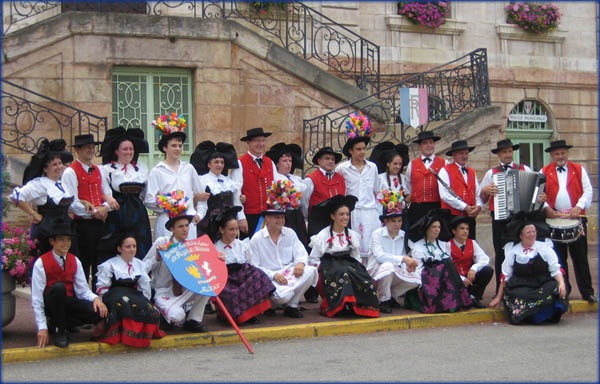
This has very little to do with the post, but these are traditional Alsatian costumes. Photo from http://hanau.folklore.free.fr/

That weekend, we were invited out to a Christmas market in Dachstein** by Annie, a friend of Amynah’s from her institute, and her husband Jean-Luc. The market was much like Strasbourg’s, in that there were thousands of slack-jawed tourists wandering around not buying anything from a bunch of bored looking stall-keepers while Dachsteiners in period costume wandered around.


Annie is a collector of the local pottery, of which Amynah and I are also big fans. We had a couple of pieces already, both of which were completely functional: a tea-set, and a pot designed for choucroutte in which Amynah cooks her briyani. Annie is personal friends with the potter who made our tea set and so, after the Dachstein market, invited us to an open house he was having in his workshop in Betchdorf, north of Strasbourg.

Amynah and I were, as far as I could tell, the only people there who were not already friends of Monsieur Remmy, who, entranced that such exotic Canadian creatures as us would know and appreciate his art, introduced himself to us and spoke to us for a good ten minutes, despite the other sixty-odd guests demanding his attention.
In any case, with that kind of treatment it behooved us to buy a few items, and so we walked out with a vase, two ornaments, a soup bowl and a second teapot (“For guests!” says Amynah).

The problem, we discovered on coming home, was that we had no place for all these lovely items. The window-sill is too risky a spot for the vase, and there’s no spare shelf space for the teapot.

And so we discovered the first law of stuff; namely, stuff begets more stuff. In order to display the lovely pottery to best advantage, we needed to purchase an end-table or shelving unit of some sort.

And so, the following weekend, we trudged off to Emmaus, the French equivalent of the Salvation Army thrift store. From there we purchased an end table… and why not another end table? And why not a small lamp to put on the end table? And why not a few more glasses while we’re at it? And so, after living a year and a half like monks, in the last few months of our expected time here, we finally cracked and moved in.


One of the end tables, with some of the pottery. Consumerism has given my life new meaning.


* By we, I mean me. Amynah had no extraneous crap in her life until I came along.

** Though Annie and Jean-Luc are from Alsace, I was the one who ended up giving directions to get to the village, as I had been twice before and it was their first time. This, combined with my recent Speedo acquisition, has confirmed me as a true Frenchman.

Monday, November 26, 2007

I'll be home for Christmas

Well, I won't, but if the Mark won't go to the Mont-Royal, the Mont-Royal will come to Mark.

Each year, Strasbourg hosts the oldest or biggest Christmas market in France/Europe (I'm a little fuzzy on the details, as you can see).


There are markets like this over most of the city. Roughly one-in-five booths sells "gluwein" (mulled wine) meaning that it is possible to get completely hammered while doing one's Christmas shopping. I will refrain from commenting on the utility of this innovation.

Each year, a country/region is asked to be a "guest" of the market, and set up stalls selling their traditional foods and handicrafts. In addition, performances and displays of art are mounted throughout the month from that culture. The invitee market is always set up on Place Gutenberg, next door to my building. Last year, in honour of their joining the EU, the guest was Romania.

Anyone care to guess which maple-syrup loving, strong-beer making, Celine-Dion-producing people were the guest of honour this year?

Right now they're playing a CD of Christmas carols by the Montreal Jubilation Choir. And while there's no shortage of weird little plastic Native American knick knacks for sale, not to mention a booth selling Fin du Monde and Maudite beer, I have yet to see any sign of either a merchant offering either poutine or Montreal bagels.*

Nonetheless, this is doing nothing for my seasonal homesickness.


* I know I'm really missing these; at a recent dinner with friends I described them as "round and golden, like the haloes of angels."

Le week-end

Went to see our arguably competent doctor on Saturday, in order to get some vaccinations for some travel we might be doing next year. I mentioned to him that I might have had these vaccinations before, but had lost my records and couldn't recall. The good doctor, who seems to believe that speaking quicker will help me better understand his poorly enunciated French, launched into a long discourse on the nature of the drugs he was prescribing and their potential effects. In any case, I heard a lot of negative sounding French words, but lost the thread of what he was telling me pretty early on in his speech. Nonetheless, I sat, mind wandering, nodding and saying "Oui" at the appropriate junctures. I snapped to attention at the five minute mark when he reached his big climax: "But there's no proof of any of that." No proof of what now?

Later that night, unsure of how long I had to live, I went out Saturday night with my language exchange partner Caner to felicitate our mutual friend Sebastien, who will be a father in a little more than a week. We went to see a local football/soccer match. Let me tell you, nothing makes sitting in the freezing cold for two hours while being deafened in one ear by the shrieks of over-stimulated French children worthwhile like a final score of 0-0.

Thursday, November 22, 2007

This day in history

... marks the end, 89 years ago, of the short-lived Bolshevik Republic of Alsace, declared in Place Kleber (briefly renamed Place Karl Marx) on November 18 and crushed four days later by French troops, who took advantage of the situation to repatriate the region from Germany.

It was a good four days to be a communist.

In Strasbourg, the date is marked by Rue Novembre 22, one of the larger streets in town. You can trace the progress of the French army through Alsace this way - I noted a few villages on our route with Rue Novembre 23's, and presumably further North you can stroll down a Rue Novembre 21.

Tuesday, November 20, 2007

Holy hike!


The Fall of France

So, this past weekend we decided to go for a short hike with our friend Sami the Finn. Sami the Finn is a pretty active guy – our most ambitious and delicious ventures into the local countryside tend to be at his instigation.

This time, he suggested a relatively moderate three-hour hike near Saverne, slightly to the north of here. This in itself would not provide sufficient “extremosity” to qualify as a true Sami the Finn hike. However, I believe our dour Nordic friend was counting on the forecast fifteen centimeters of snow to provide the challenge he requires for such endeavours.

Sadly, it was not to be. The day dawned as pretty much all days dawn when we’re doing something that will require us to be outside a lot: cold and foggy.


Don't leave me here!

While I was delighted with the fog, Amynah pointed out that there was hardly any point in climbing a big ole hill in order to see a thick mist that would be equally well viewed from the interior of a cozy restaurant.

Nonetheless, we came to climb, and climb we did. Due in part to the fog, and in part to somewhat unclear trail markings, we ended up taking a shortcut that effectively eliminated most of the actual trail.


We weren't the only ones confused, apparently

We saw fog enshrouded trees and fog enshrouded rocks, and a few fog-enshrouded trails, none of which were those that we were supposed to be on. Eventually, roughly at the moment we were going to give up, we stumbled upon the fog-enshrouded castle that was supposed to mark the last 1/8 of the planned hike. At this point, we’d only done, by my estimation, 1/4 of the distance we were supposed to so evidently the local fog was the result of a rip in the space-time continuum.


Yawn. Another romantic castle ruin.

We hiked up to the castle, snapped some photos, and then decided to wander a little further along a side trail which turned out to be the tail end of the trail we were supposed to have been on all along.

Here we stumbled upon the Grotto of St Vitus, a medieval pilgrimage site for those seeking the Saint’s protection against epilepsy. The site is still very much in use, with a well-tended garden and pond. The grotto itself contains a small chapel, which holds services right up until September.


It's a trap, I tell you! A trap!

This is a risk of hiking in the forest around Alsace. I have, by my count gone on at least four pilgrimages since coming here, all quite by accident. You never know when you’re going to stumble onto one of these things – chapels litter the forest like bear-traps, baited with the promise of redemption for the unwary. I don’t think it’s quite right that one should be at risk of having one’s soul saved when all one wants is a nice walk in the woods, do you?

Greve-digging II: The comeuppance

Further to my last post: As part of the Kafka-esque bureaucracy in France, I am required roughly every two months to present myself at the local “Tresor Publique” to pay taxes, correct their forms, fills out new forms and try to convince them that despite our different last names, Amynah and I are actually married.

One of the more tiresome chores is the need to repeatedly explain to them that, as I do not own a television, I will not be paying the television tax (such a thing does exist here). Yet every once in a while, they’ll send me a new bill demanding that I pay it.

Today, I went up once more, planning on speaking in French so tortuous so as to make the inutility of my owning a television self-evident. However, on arrival they were closed, in sympathy for the greviste etudiants.

That’ll teach me to question the power of the student unions.

Greve-digging


Striking students. Sadly, I've nothing funnier to add to that

As I’ve noted before, one of the joys of living where we do is never wanting for entertainment. From here we can see such wonders as the Cathedral light show, bike races or, famously, Napoleonic disco zombies.

One of the more frequent sights out my window are street protests, a sight Le Monde tells me is likely to become even more common in the days to come.

Today it was the students. Now, I don’t want to get into the ins and outs of why they’re striking, as I’d probably get it wrong anyhow, but I really must ask: what vital service are students providing that their striking would be a threat worth taking seriously? I was on “strike” for the first two years of my undergraduate degree, and no one - not even my professors - ever noticed.

In any case, what I’ve observed about these manifestations is that they all, without exception, feature a pickup truck bearing a small rock n’ roll combo, belting out rousing tunes custom composed for the occasion.


On the road again...

Given that I was ill yesterday, and am therefore still a little giddy from lack of food, when today’s parade of discontent passed, I was left wondering how these guys come up with their songs. Is there a “Defending the social-contract in three-chords” songbook? Or are some gallic Lennon and McCartney spending their nights hopped up on bennies, churning out new lyrics for the cause du jour?

“Jacques, mon ami, what rhymes with Sarkozy?”

“Solidarité? It is close enough, no?”

“Ah, but we used that for the electricians strike, just last week. Our fans demand more of us!”

“I am not a machine, Jean-Paul. This is an art! One cannot just rhyme “revolution” with “etudiant” and call it poetry! There must be passion!”

"Do not be so hard on yourself Jacques. We cannot write an opus like "No to the reform of municipal blue-collar pensions" every time."

All right, I obviously need some lunch.

Thursday, November 15, 2007

On a lighter note...

In French class yesterday we were doing an exercise to help us master the future conditional, in which we would ask each other questions like "If you could travel anywhere in the world, where would you go?"

At one point, I was asked if I could eat any meal, with a dining companion of my choice, what and who would it be. Taking my role as class clown seriously, I answered duck (I do love me some duck), which I would eat with Kate Moss, adding "That way, there would be more food for me."

Later I was asked if I could be anyone in the world for 24 hours, who would it be, and what would I do. Again, thinking I was being clever, I answered Bill Gates, and I would give all my money to Mark Reynolds.

Topping me when his turn came, Gabor, my Hungarian classmate, answered without batting an eye "I'd be Kate Moss, and go to dinner with Mark."

Battle weary


Vimy memorial. Note the churned earth and sign to the right warning of unexploded shells

Note – I suspect the following post is a wee bit self-righteous, and possibly even somewhat pompous. Forgive me, I do get worked up sometimes.

I had intended a Remembrance Day post here about my visit, with my family, to Vimy Ridge last month. Unfortunately, the day we went to the memorial I forgot to bring my camera, and thus decided to wait until my Dad’s CD of his pictures arrived. Given that my Dad’s a far superior photographer, you can count yourself lucky.

In any case, I’ve ranted about Vimy’s place in Canadian history before and my opinion on that score is unchanged.

That said, that despite the Parks/Heritage Canada presentation of the site, the memorial is very moving. It is staffed by fresh-faced college girls reciting troop numbers, pointing out soldiers’ graffiti and scrupulously avoiding the topic of just who all these Canadians were in France to kill. Ask where the German trenches were and a vague hand is waved “over there.” German cemeteries are nowhere in evidence, German casualties never mentioned. Overall, the displays in the visitors centre are more about the act of “remembrance” itself than about what, precisely, we are supposed to be remembering. Needless to say, the site repeats the old trope that so enrages me about how Vimy proved to Canadians what we, as a nation, could accomplish


Death's tool chest in the tunnels. Not historic enough

At the risk of sounding needlessly provocative, what “we” achieved that day was monstrous. And it is this, no matter how much the myth-makers back home try to paper this over, is what the Vimy Memorial presents quite well.

The land around the battlefield is, ninety years on, pitted and scarred with shell craters, laden with unexploded ordnance. Two graveyards, filled with tombstones marked with nothing more than “A Canadian soldier” speak not just to the massacre here, but to the heartbreak of families back home who would never know what happened to their sons.


Canadian cemetery at Vimy

Vimy was won underground – an enormous network consisting of miles of tunnels allowed troops to burst onto the battlefield undetected. In these, old grenades, rifles and barbed wire fencing rust away, handled occasionally by some English major from Bathurst or Toronto who explains how they were improved upon over the course of the war to better aid the massacre.

And this, to me, is what makes this a monstrosity. So much effort, so much human labour and ingenuity spent improving the efficiency of the machinery of death.

Adolph Hitler famously visited the Vimy memorial in the 1930s, having been a runner in that sector of the front; he was invalidated out just prior to the Canadian assault. After invading France, he specifically ordered that the Vimy memorial be spared the Nazi programme of destroying war monuments, reasoning that our memorial did not express triumph over an enemy, but rather sorrow over the loss. How anyone could walk through those cemeteries or see those tunnels and think to repeat the exercise, then or now, is beyond comprehension.


Memorial detail

It does not take much of an imagination or sense of empathy to imagine what hell waiting in those tunnels must have been, feeling the reverberations of shells rumbling through the stone above you, knowing that eventually you would have to venture into the slaughter outside and, if you survived, walk up to a perfect stranger and kill him. It takes no great mental effort to imagine the lifetime of heartache a “Missing and presumed dead” telegram would bring a mother, wife, brother.

A word like “pride” has no place in reference to something like Vimy, and sadness is useless. I left Vimy angry, and I’m angry still.

Monday, November 05, 2007

Complaints choir

Just read this story about the Finnish complaints choir (video below, and it's hilarious).


The song is made of complaints submitted by choir members. My favourite from this one is "We always lose to Sweden in Eurovision and hockey." What would your complaint be? Mine would be people who zig-zag slowly across sidewalks, thwarting my attempts to pass them.

Share - it's good for the soul.

Friday, November 02, 2007

Ahead by a century


And we're off - the odometer at zero

Our two-year anniversary having coincided with my parents visit, Amynah and I decided to celebrate it this weekend. The “weekend” in this case having started Thursday, in honour of All Saint’s Day.

We decided to go with a “two” theme for our celebrations, (as opposed to cotton or china, as is apparently traditional) and thus dragged out our two-wheeled means of transportation (both second-hand, appropriately enough). Our destination: Basel, over one hundred kilometers away (we thought it was 120 km. Oh, what naïve fools we were!)

I had made an offhand suggestion to do this some time ago, and earlier this week had, without any sincere regret, mentioned that it was a shame that we hadn’t had a chance to do it this summer. My wife, being insane, said we should so it now, on the first of November, when neither of us had really been biking much at all for months.

In preparation, in the days leading up to our journey, I resolutely refused to think about it, on the assumption that a) Amynah would come to her senses or b) if she didn’t, I was better to not be dreading the misery ahead.

Nonethless, I made sure the brand-new odometer my younger sister and her fiancé bought me for my birthday was functional, and invested in a bike lamp, rack and pannier bag.

The forecast for Thursday was sunny, with highs in the low teens. However, the day dawned with a thick, cold fog blanketing Alsace, and temperatures hovering around five degrees. Also, I had the beginnings of a migraine.

Deciding to ignore it, and I still in the hopes that Amynah would admit to the whole enterprise being a practical joke, we saddled up, and headed to the Rhine-Rhone canal, that we were planning on following pretty much all the way to Switzerland.

It was not to be. Somewhere past Illkirch, we hit a “deviation” which sent us wandering through farmer’s fields and the empty little villages of Hipsheim and Nordhouse. This added at least 15 km, one hour of map-contemplating backtracking, and two or three extra degrees of pain in my head.


The detour through the land that God forgot

After getting back on the canal (after asking about six different sets of direction from six different people) we stopped for lunch at the fifty km mark. Damp and cold from the fog, nauseous from my headache and already aching, we decided to call it a day if we made it as far a Selestat, another 25 km away. Ignoring the strong smells emanating from the nearby hog barn, we choked down our sandwiches and pushed on.

Then, a miracle occurred – a cruel, terrible miracle. The fog began to lift, the clouds parted, and the sun came out. Suddenly our miserable slog through a brume-choked wasteland became a pleasant ride through sun blessed Autumnal countryside. Worse, my headache, which in retrospect I am convinced was my body urgently hammering the “Eject! Eject!” button, went away.

Soon, the villages began to fly by: Witternheim, Bindernheim, Wittleheim, Boesesheim, Schlobsheim, Hessenheim, Marckolsheim, Artzenheim, Baltzenheim, Kunheim… they all blended into one glorious “heim.”

We did, however, keep losing the route. At the 90 km mark, we stopped in a village (Bielsheim) and accosted a spandex-clad gentleman on a kitted-out racing bike, figuring he’d know all the local routes. His wide-eyed reply, on being asked where the route to Basel was, “Oh, you’re ambitious.”

Failing to take that as the warning it was, we pushed on. Sunset greeted us near Nambsheim, just as we hit the 100 km mark.

Soon, we were biking in the dark. And let me tell you, dark in an Alsatian village on All Saints Day is dark indeed. Worse, the fog of the morning arrived for an encore performance, penetrating our clothes, and chilling us to our very bones.

Soon, we were reduced to pedaling, half-frozen automatons, half-hoping the few cars that would appears out of nowhere in the foggy night would put us out of our misery. Balgau, Blodelsheim, Rumersheim-le-Haut… at Blantzheim we gave up on the bike paths, as my headlamp was failing in the cold and the only illumination we had was therefore coming from passing cars on the highway (Amynah’s bike had a generator-powered lamp but, as she was wearing a white jacket while I was wearing a black coat over a black fleece over a black t-shirt, I needed her nice and visible behind me).

Ottmarsheim, Petit-Landau, St Martin, Niffer, Kembs… we were beginning to run out of time. It was pushing 8 pm, and the last train left Basel back to Strasbourg at 9:20. We hadn’t brought enough for dinner, and I was paying less attention to the road – after the 130 km mark – than I was to the visions of the Basel Burger King, the only representative of that fine culinary institution I’ve seen in Continental Europe. My half-congealed brain wondered whether I should order two Whoppers at the same time, or each singly, to receive them at maximum heat. The coffee, I decided, would be poured directly over my feet which, having done nothing but sit on my pedals all day, had frozen solid.

Richardhaueser, Rosenau, Village-Nuef… at St Louis we were fooled by the directional signs which, in an effort to reduce traffic through their downtown, directed those seeking Basel to the Autoroute, a passage not recommended for two exhaused Canadians on bikes. After that detour, we zipped through Swiss customs, cheering and whooping. Though they don’t check passports there anymore (thank god: we had forgotten ours) we wanted to stop and tell the guards “Do you know where we just came from?”


Happy to be in Basel, and Basel's happy we're there.

At this point it was about 9:30 so, after snapping a photo of the carnival the people of Basel were throwing in honour of our accomplishment, we headed directly to the train station, with a plan to buy our tickets, and then run to the Burger King across the street. We got to the wicket, and the lady told us that the last train was leaving in five minutes, on track 12 – a four-minute walk away.

“Burger King….” I moaned, piteously, as Amynah started to run to the platform. We caught the train, and sat, shivering, sore, devoid of thought. Whatever sense of accomplishment I felt (it’s still sinking in) was overwhelmed by the unpleasant sensation of what it feels like to cry burger-deprived tears when you don’t actually have any liquid left in your body.


It's hard to read because of the crappy light, but trust me, it says 163 km. It took us 12 hours (nine and three quarters of actual riding) at just under 17 km/hr average. Given that Amynah rides a bike stitched together from old tin cans that has only three speeds, I will choose to believe this is impressive.